
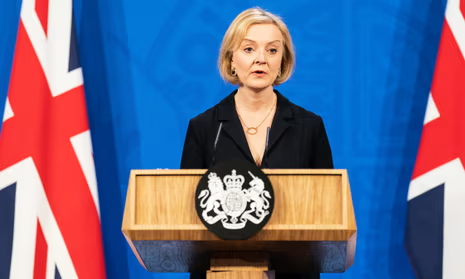
ircicaarchdata.org – Mary Elizabeth Truss, known as Liz Truss, is a British politician who served as the Prime Minister of the United Kingdom from September to October 2022. A member of the Conservative Party, Truss’s political career spans over two decades, marked by both significant achievements and controversies. Her time in office was brief but left a lasting impact on the nation’s political landscape.
Early Life and Political Beginnings
Born on July 26, 1975, in Oxford, England, Liz Truss was raised in a middle-class family with a strong academic background. Her father, a professor of economics, and her mother, a nurse, encouraged her to excel in her studies. Truss went on to study Philosophy, Politics, and Economics (PPE) at Merton College, Oxford, where she became actively involved in politics, joining the Oxford University Liberal Democrats before later switching to the Conservative Party.
Her political journey began in the early 2000s when she was elected as the Member of Parliament (MP) for South West Norfolk in 2010. Truss quickly established herself as a rising star in the Conservative Party with her strong stance on free market policies, education reform, and fiscal conservatism.
Climbing the Political Ladder
Liz Truss’s political trajectory was marked by her rapid rise through various cabinet positions. She served as Secretary of State for Environment, Food, and Rural Affairs from 2014 to 2016 and was later appointed as Secretary of State for Justice and Lord Chancellor, making history as the first woman to hold the latter position.
Truss’s reputation as a champion of free-market economics and deregulation grew during her tenure as Secretary of State for International Trade. She played a key role in negotiating post-Brexit trade deals, positioning herself as a staunch advocate for global Britain and its economic future outside the European Union.
Becoming Prime Minister: The Unlikely Rise
In 2022, following the resignation of Prime Minister Boris Johnson amidst political turmoil, Liz Truss was elected as leader of the Conservative Party. Truss’s campaign focused on tax cuts, deregulation, and strengthening Britain’s economy. Her victory was seen as a bold move by the Conservative Party, opting for a leader who promised to steer the country in a new direction after the Brexit process.
The Truss Premiership: A Brief and Controversial Term
Truss’s tenure as Prime Minister was one of the shortest in British history, lasting only 44 days. Her premiership was immediately marked by the unveiling of a controversial “mini-budget” that proposed significant tax cuts, particularly for the wealthiest, alongside large-scale borrowing to finance these policies.
The reaction to her economic plans was swift and harsh. Financial markets reacted negatively, with the pound plunging to historic lows, and the Bank of England was forced to intervene to stabilize the economy. Truss’s position quickly became untenable, and she faced mounting criticism from both the public and within her own party.
Resignation and Legacy
On October 20, 2022, Liz Truss resigned as Prime Minister, acknowledging that she could not deliver on her promises of economic growth and stability. Her brief time in office was a cautionary tale of the volatility of political leadership and the challenges of implementing bold economic policies in a complex, post-Brexit world.
Though her tenure was short, Truss’s legacy remains a topic of debate. Some view her as a victim of circumstances, with her leadership overshadowed by the global economic uncertainty and the aftermath of the pandemic. Others criticize her economic agenda as out of touch with the realities of the modern British economy, particularly in light of the cost-of-living crisis that plagued the nation during her time in office.
Conclusion: A Political Figure Shaped by Controversy
Liz Truss’s career reflects both the potential for bold leadership and the risks associated with pursuing radical economic policies. While her premiership may have been brief, it has left a lasting impact on British politics, prompting debates about the direction of the Conservative Party and the future of economic policy in the UK.
As Truss continues her political career, it remains to be seen how history will judge her time in office. Will she be remembered as a reformer who sought to transform the British economy, or as a leader undone by the complexities of modern governance? Only time will tell.
